![]() |
|||
![]() |
![]() |
||
|
|
|||
|
|
|||
![]() |
|||
|
May
17-19
|
Takeguchi Shihan at Capital Aikido - Lincoln
Takeguchi Shihan will instruct in Lincoln, Neb. Please visit the CAL web site for details.
web link
|
|
May
18-19
|
Poresky Sensei at Western Maryland Aikikai
Bob Poresky Sensei will teach a weekend seminar at Western Maryland Aikikai. Details on the WMA web site.
web link
|
|
May
26
|
Cigku Sam Sheikh Shamsuddin at Mushin Aikido
Mushin Aikido will host an afternoon of Silat Seni Gayong with guest instructor Cigku Sam Sheikh Shamsuddin. Class begins at 4pm. Please contact Joe Neu for additional seminar details. More information on Silat Seni Gayong can be found at www.malaysilat.org
web link
|
|
May
31-2
|
Mike Friedl Sensei at Capital Aikikai
Mike Friedl Sensei, of Aikido of Ashland, will teach at Capital Aikikai. Details TBA.
web link
|
|
Jun
22-23
|
Shifu Zhang Yun at Capital Aikikai
Yin Cheng Gong Fa and Capital Aikikai will host Shifu Zhang Yun for a weekend seminar of traditional Chinese martial arts. Shifu Zhang Yun is a master of Taiji, Bagua, Xingyi, Tongbei, and Changquan, having studied and taught for nearly five decades in China and the US. Please visit the Yin Cheng Gong Fa web site or contact us directly for details.
web link
|
|
Jul
19-21
|
4th Annual CAF Gasshuku
Please join us for the 4th (!) Annual CAF Gasshuku to be held this year at Capital Aikikai. Details forthcoming.
web link
|
|
Sep
21-22
|
Millar Sensei at Capital Aikikai of Syracuse
Dave Millar Sensei will teach a weekend seminar at Capital Aikikai of Syracuse. Details on the CA-Syracuse web site.
web link
|
|
Sep
27-29
|
Friendship Seminar with Takeguchi and Hendricks Shihan
Potomac Aikikai will host a friendship seminar with Clyde Takeguchi Sensei (CAF) and Pat Hendricks Sensei (CAA). Details on the Potomac web site.
web link
|
|
Nov
1-3
|
Poresky Sensei at Mushin Aikido
Bob Poresky Sensei will teach a weekend seminar at the Mushin Aikido dojo. For details, please contact the Mushin dojo at 630-269-6818.
web link
|
|
Nov
1-3
|
Endo Shihan at Capital Aikikai
Seishiro Endo Shihan will once again be joining us at Capital Aikikai. Details TBA.
web link
|
|
Dec
7-8
|
Takeguchi Shihan at Capital Aikikai of Syracuse
Takeguchi Shihan will teach his annual seminar at Capital Aikikai of Syracuse on 7/8 December. Details forthcoming on the CA-Syracuse web site.
web link
|
Our member dojo compose a diverse group, from across the United States:
CAF ranks are recognized by Aikikai Hombu dojo and the International Aikido Federation.
The Japanese word Aikido is written with three characters which translate as "the way of spiritual harmony." Aikido is a budo or "martial way," evolved in the tradition of Japanese warrior arts, yet has a unique approach to self defense. Aikido is more than a martial science of strategy and tactics, it is a discipline for training the mind and spirit.
Aikido was developed by Morihei Ueshiba (1883-1969), known to Aikido students as O Sensei (Great Teacher). As a young man, he overcame debilitating childhood illnesses through martial arts practice, eventually becoming a master of the sword, the staff, the spear, and the art of ju-jitsu. O Sensei also held strong Shinto religious convictions concerning the ultimate futility of conflict and the illusory character of victory based on strength. This internal contradiction, which drove O Sensei to adopt a life of austerity and rigorous training, was resolved through an enlightenment experience which led to the development of Aikido, a martial art influenced by a philosophy of universal harmony.
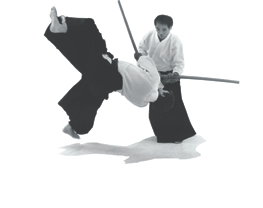
Properly executed, some techniques are spectacular, sending the opponent flying through the air. Others are more subtle: small deft movements that immobilize the aggressor. Both results are achieved not through the use of brute strength, but by blending and neutralizing the attack, followed by circular and flowing techniques to unsettle the opponent, and completing the movement with a throw or immobilization. Because great strength is not required, Aikido can be practiced by men and women of all ages.
Most practice is done with a partner: each working at his or her own level of ability, alternating as uke (the attacker) and nage (the one who is attacked). Both roles are stressed; each contributes skills that enhance overall sensitivity and control.
Wooden practice weapons — a sword (bokken), staff (jo) and knife (tanto) — are sometimes used in aikido training, not to understand how to use the weapon, but to better understand the techniques and movements of aikido itself.
Students train to neutralize the energy of the opponent's attack and to redirect and focus it into techniques of martial efficiency and power. At the same time, the student can use the same philosophy to deal with stress and conflict in daily life, and learn to remain calm under all conditions.
In Aikido, such an integrated person is said to be "centered." A centered person displays a confident and relaxed posture, and centering gives Aikido movements their appearance of grace and simple elegance. Thus, Aikido training helps a student to become calm and centered and enables the student to deal with stress and aggression in an efficient and decisive manner on the mat, at home, at school, or at work.